
September 28, 2026
AI Is Changing Education. So We Took Language Arts Offline.
LearningAI
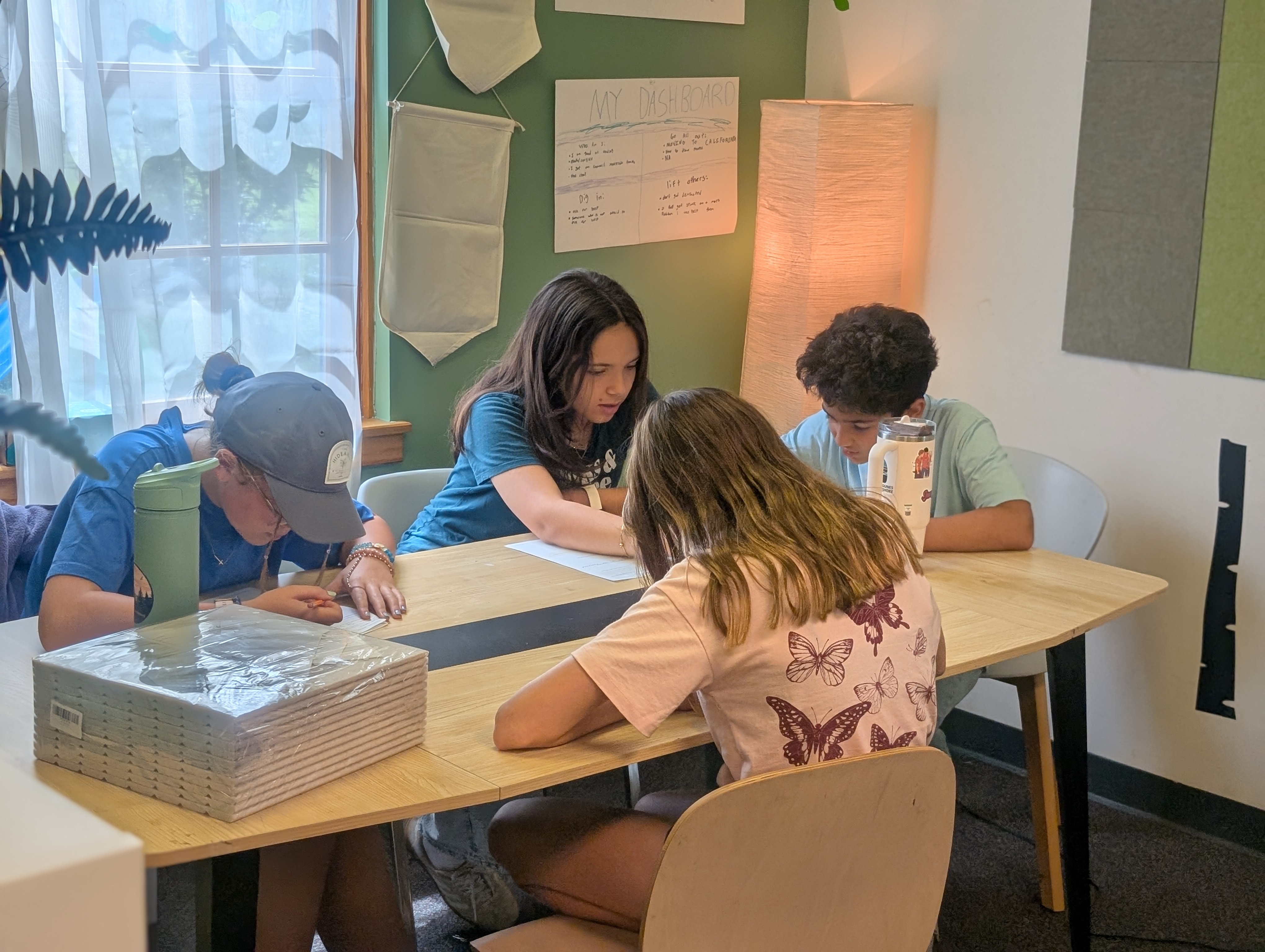
This year, we made a fairly significant change in our middle school studio at Acton Academy Columbus: we moved Language Arts completely offline. Our learners still use computers, and we certainly aren’t trying to shelter them from technology. They are growing up in a world where AI will be an incredibly powerful part of their lives, and we want them to become exceptionally good at using it. But increasingly, we believe that preparing children for a world filled with AI also means being more intentional about the things we ask them to do without it.
Our decision actually started before our concerns about AI. We had been watching how learners interacted with academic work on a computer. There were enormous benefits, but we also saw how easy it was to rush, click through an exercise, guess and move on, or simply focus on getting to the end. Even when a learner was technically doing Language Arts for an hour, we weren’t always convinced that meant they had spent an hour reading deeply, thinking deeply, or writing deeply.
That forced us to ask a more fundamental question: What are we actually trying to accomplish with Language Arts?
For us, the answer isn’t that a 12-year-old can identify a subordinate clause. That doesn’t mean grammar is unimportant. Learners need to understand punctuation, sentence structure, vocabulary, spelling, and the mechanics of clear communication. But those are tools in service of something larger. If a learner can correctly label every part of a sentence but struggles to develop an original idea, explain why she believes something, support an argument with evidence, or communicate a complicated thought, we’re not sure we’ve accomplished what matters most.
Our focus instead has increasingly become deep writing. We want learners to sit with a difficult question long enough to discover what they actually think about it. We want them to make an argument, support it, question it, and sometimes realize halfway through that it doesn’t hold together as well as they thought. We want them to encounter opposing ideas, consider them fairly, and decide whether those ideas should change their own thinking. The finished piece of writing matters, but the process required to produce it matters just as much.
That’s because writing does something unusual to the brain. You can carry an idea around in your head and be absolutely convinced that you understand it. Then someone asks you to explain it on paper, and three sentences later you discover that you don’t understand it nearly as well as you thought. You can’t find the right words. One idea doesn’t logically follow another. You realize that something you considered a fact is actually an assumption. You have to stop, reconsider, cross something out, and try again.
That frustration is easy to see as an obstacle to learning. We’re increasingly convinced that it is the learning.
And that is where AI makes this question much more urgent.
AI is rapidly eliminating much of that friction. A learner can give an AI tool a question and receive a well-organized answer almost immediately. It can develop the argument, create the structure, suggest evidence, anticipate the counterargument, improve the grammar, and write the conclusion. The resulting essay might actually be better than anything the learner could have produced alone.
But the essay isn’t really what concerns us most.
What concerns us is what happened inside the learner’s mind while producing it.
There is an important difference between an adult using AI after decades spent developing the ability to read, reason, write, question, and communicate, and an 11-year-old using AI while those abilities are still being formed. If the machine organizes an argument before you’ve struggled to organize one yourself, you may get a better argument, but you also lose an opportunity to practice organizing your thoughts. If it supplies the counterargument before you’ve tried to understand the other side, you lose an opportunity to develop perspective. If it finds the words every time you struggle to express something difficult, you may never become quite as good at finding those words yourself.
This is one of the reasons paper has become more important to us, not less. A blank piece of paper is wonderfully inefficient. There is no autocomplete, no instant correction, no green checkmark, and no other tab waiting to be opened. A learner has to sit with an idea. Writing by hand slows the process down enough that thinking becomes difficult to avoid.
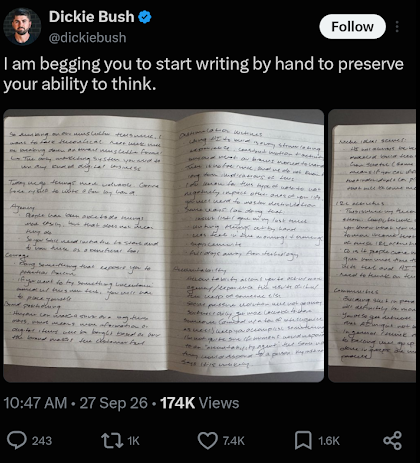
We aren’t the only ones noticing this. The idea that handwriting preserves the ability to think is showing up more and more, and not just from educators.
We think this matters because the scarce skill in our children’s world is changing. Information certainly won’t be scarce. Neither will competent writing, polished presentations, summaries, explanations, or answers. Our children will carry tools capable of producing all of those things almost instantly. What may become far more valuable is the ability to decide whether an answer makes sense, recognize a weak argument, ask a question nobody else thought to ask, connect ideas, defend a position, understand someone who disagrees, and change your mind when the evidence warrants it.
Those aren’t primarily writing skills. They’re thinking skills. But writing may be one of the best ways we have to develop them.
None of this means we want our learners to avoid AI. Quite the opposite. We want them eventually asking AI to challenge an argument they have already developed, expose weaknesses in their reasoning, present evidence they haven’t considered, or make the strongest possible case against their position. Used that way, AI could actually demand more critical thinking from our learners rather than less.
The sequence, however, matters. We’re increasingly drawn to a simple idea: your brain first, AI second. Develop a thought before asking a machine to develop it for you. Struggle with a question before asking for the answer. Put something on paper before asking AI to make it better. Then use this extraordinary technology to push your thinking somewhere you couldn’t have taken it alone.
Moving Language Arts offline might look like a step backward. We think it may actually be a response to where the world is heading. If AI makes producing good writing incredibly easy, then producing good writing can’t be the ultimate objective of Language Arts anymore. The deeper objective has to be developing young people who can think critically, wrestle with complexity, form their own ideas, and communicate those ideas clearly.
The better AI becomes at writing for our children, the more important we think it becomes that we continue asking them to write for themselves. Because the most valuable thing produced by a difficult piece of writing may not be the essay at all.
It may be the mind that had to struggle to create it.